Tuesday, January 15, 2013

As the phoenix rises from the ashes, so too will RGIII!

Hyperbole maybe. Let's be honest; millions of people, professional athletes included, have had this procedure, had excellent physical therapy and returned to nearly, if not completely, 100%. However, Robert Griffin III holds a special place in the hearts and minds of everyone in the Metro DC area and for many in and around professional football.
 
I was recently asked to contribute to a piece on Robert Griffin III regarding his ACL reconstruction, his expected course of rehabilitation and the likely prognosis for a full recovery. I was happy to help a dear friend of mine and a friend of SPARK Physiotherapy, Fairfax Hackley with his weekly segment on WTOP (103.5FM).
 
Here is a link to the piece that was aired on Monday, 1/14/13 at 2:20PM on 'Hack's Best Body Report': RGIII ACL recovery from WTOP with Fairfax Hackley
 
The  main question asked was 'what's in store for RGIII with regard to the specifics of the surgery and his recovery'. One of the most important details here is the type of graft being used to repair his knee. For this surgery, they chose to use a patellar tendon-bone graft (PTB) which has some advantages over other grafts. 
 
RGIII did, in fact, undergo two separate procedures for this reconstruction. A PTB graft can be taken from a cadaver or from the patients own knee when it's appropriate. The PTB graft was harvested from RGIII's left knee and arthroscopically implanted into his R knee. If the right knee didn't previously have a PTB graft removed in 2009 when he first tore that ACL this surgery would only have been slightly less complicated.
 
Below is a great video that shows what this surgery looks like.
NOTE: the video depicts most of this without the skin and muscle in the way, but in fact, most of either procedures are done with minimal incisions and the entire ACL implantation is done through very small portals (.5-1.0 cm incisions) and small video cameras. 
 
 
Immediately after surgery, the main goal of the medical and physical therapy teams is to decrease any chance for infection and blood clots. No matter how young or in shape the patient, we are all susceptible to these problems if precautions are not taken. For the first week or two, blood clots are managed by gentle movement of the joint by RGIII and his physical therapist(s). He will use crutches to get around for the first week to 10 days and he'll wear an immobilizer brace that protects the surgery while he's moving around.
 
Once the initial phase of recovery is complete, at around the 2 week mark, the main focus of the rehab is to maximize the protection of the newly implanted graft. All movement will be highly controlled placing very little to no stress on the ACL. During this time the PT team will work with RGIII on exercises that will prevent weakening of his quadriceps, glutes and further decrease his swelling and inflammation.
 
The next phase of rehab, typically at 4-weeks post-op, will bring us to a stage where more care can be taken to regain range of motion muscular control over the knee, hip and foot. This is also the stage where RGIII will resume walking on his own even if it is with a slower pace but at least he'll be without the crutches or brace now. As long as his range of motion has continued to improve and the swelling has continued to decrease, the overall intensity of PT will start it's climb! Good times!!
 
As the physical therapy team approaches the 8-week mark, things get fun but they are still keeping a close eye on the intensity of movements that might place the new graft at risk. The bone that is attached to the ends of the PTB graft is fully attached to it's new place. BUT at roughly the 10-week mark, the actual tissue that the PTB graft is made of is undergoing a transformation that makes it quite a bit weaker even though he will be relatively pain free. Special care will be taken at this point to ensure everyone is on the same page about this!
 
Once we're at 12-weeks or so, we're mostly in the clear and the real fun can begin. PT becomes more about introducing plyometrics (jumping and bouncing exercises), introducing light running and intensifying his "closed-chain" training (movements like squatting, lunging, etc).
 
All told, recovery from this type of ACL reconstruction should take anywhere from 4-6 months. Everyone responds to surgery and treatment differently. RGIII has the best and brightest working with him every day to ensure he'll be back to terrorize defensive coordinators in NFC East for many years.
 
We at SPARK Physiotherapy wish him the best of luck for a full return to play.


Wednesday, January 2, 2013

Run for Life: Part 2

Welcome back to Run for Life: Part 2. We will continue with another common running injury…


Injury #2: Iliotibial band syndrome (a.k.a. IT band syndrome/ITBS)

This is another chronic inflammation issue where the IT band, which is the big band of connective tissue on the side of your leg, becomes irritated due to overuse and poor mechanics. Not only does it alter normal running mechanics, but commonly causes lateral/outside knee pain or hip pain because of strain at its attachment sites. Similar to treatment of plantar fasciitis, usually the IT band needs to be mobilized in order to break up any “sticky spots” that develop within the tissue as well as the muscle that attaches to it tensor fascia latae (TFL).


Self-treatment: A foam roll, tennis ball or lacrosse ball tends to be one of the best tools to aid in loosening the IT band. This is accomplished by lying on your affected leg on top of the foam roller/ball and then rolling up and down your leg, stopping at any tender points for a few extra seconds to break up the tissue. Hip strengthening and stabilizing exercises as well as proper ankle mobility needs to be part of a comprehensive rehabilitation program when it comes to IT band issues to restore normal mechanics of the leg.

If a person comes into our clinic presenting with IT band syndrome, we again put them through our Runner’s Screening Exam to assess their overall movement patterning. In our assessment, we usually find the IT band has restrictions, which may cause the leg to be pulled outward slightly due to the attachments of the IT band. As mentioned above, this is when outside knee pain may occur and overall running mechanics will likely be compromised. We recommend using the above self-treatment of tissue mobilization, but as physical therapists we can offer more efficient manual therapy to break up any tissue adhesions (“sticky spots”) in the IT band as well as specific techniques to develop proper movement patterns of the legs and spine when running.

The conclusion of Run for Life is coming up so don’t miss it!

"Running should be a lifelong activity. Approach it patiently and intelligently, and it will reward you for a long, long time." -Michael Sargent

Monday, December 17, 2012

Run for Life: Part 1

In this 3 part series, Dr. Ivy Roe, one of our talented Performance Physical Therapists and our resident running guru, will break down several issues
that plague runners in their quest for their next PR.

Plantar fasciitis, IT band syndrome, Achilles tendonitis, shin splints…any of these sound familiar? It is estimated up to 82% of runners will get injured at some point during their training. 82%!?!?!

This means that if you intend to run at almost any intensity, then you will run right into pain that will slow you down; then what do you do? Do you try to run through it? Take time off and rest. See a doctor? Ask your friends what they’ve done when they’ve been injured? (Because let’s face it, at 82% at least one of your friends has been/is injured…). In this three-part post I will describe some common running injuries, examples of self-treatment and what to do if you just can’t get back to your full health and running routine.

Injury #1: Plantar fasciitis

Plantar fasciitis is chronic inflammation of the plantar fascia, which is an important structural component on the bottom of the foot that helps with stability of the foot and ankle. Typically, a person will start to have pain in their heel especially with the first step out of bed in the morning as well as during prolonged standing, walking and running. If the plantar fascia is inflamed/irritated it interferes with normal mechanics of the foot and ankle, which then causes dysfunction up the entire leg, even causing issues up into the spine. So not only will a person have pain in their foot, but they may then develop compensation patterns leading to knee, hip or spinal pain…all because of your foot!! No need to throw in the towel, there are a few self-treatments that are effective in relieving a person’s foot/heel pain and allowing them to get back to their normal activities, especially running.

Self-treatment: First is to make sure the plantar fascia is moving correctly and that it’s not getting “stuck” anywhere in the foot. Cross your affected leg on top of the other, then press firmly into the sole of your foot looking for any tender or tight spots. When you find a spot keep your finger firmly pressed into it and using your other hand, gently bend your big toe upward toward your shin. This can help break up any scar tissue and myofascial restrictions that are not allowing the plantar fascia to function properly. Do this at least once a day followed by stretching your calf muscles. Also, ice the sole of your foot with either a bag of ice or freezing a Coke bottle and rolling your foot over it for 10-20 minutes daily especially after a lot of impact activity like running. 

At our clinic, we have developed a Runner’s Screening Exam which hones in on the areas of the body that are most important for efficient running form and tests specific areas needed for optimal running performance. For example: a runner comes in with suspected plantar fasciitis and we put them through the Runner’s Screening Exam. A dysfunction we may find is weak hip stabilizer muscles such as the gluteus medius, which will then cause increased stress on the plantar fascia from improper mechanics. We then design a comprehensive and individualized rehabilitation plan with a home exercise program to address the dysfunction/s we find and get you back to running. Not only do we correct the dysfunction/s which caused the plantar fasciitis in the first place, but we arm you with tools to prevent it from happening again.

Stay tuned for Part 2 of Run for Life

"I often hear someone say I'm not a real runner. We are all runners, some just run faster than others. I never met a fake runner." -Bart Yasso

Friday, November 9, 2012

SPARK Grand Opening Recap

Just in case you missed it or wanted to relieve the fun and excitement of our big event, we've put together this collection of pictures and a short video from our Grand Opening celebration.

The event was on November 1st and marked the official kick-off of work in our new home at 2850 Eisenhower Ave in Alexandria, VA.

After a short time of gripping and grinning we paused to thank those in attendance. There were several folks who wanted to share their stories with everyone so the following video was taken. Apologies for the low sound. New audio/visual equipment will soon show up on the shopping list!


The following are some still pics from the evening. Thanks to all who came out to show their support. You won't ever know how much your being there meant to all of the SPARK Physio staff.

If you were here you were definitely excited about a lot of the home made goodies that our clients brought in. The freshly made caramel corn was a HUGE hit!

Clients, friends, and colleagues all attended. We are fortunate to be surrouned by such talented folks.
(left to right: Carlos Berio, PT, Mike Davis, PT,
Vernessa Neamo, PFT, Ivy Roe, PT)

Our newest Team member with one of our original Team Members and his lovely fiance.
(left to right: Sara Black, PFT/CMT,
Habi Iskandar, Operations Guru, Vanessa Zottig)

Some real "Tough Mudders"!
A few members of our TM team.
(left to right: Cheryl and Duncan Kerr, Tough Badass,
David Duncan, MD, Ed Ruiz, Tough Badass)

 
Friends and family all came out to celebrate with us.
(left to right: Derrick Edwards, Heidi Berio, my beloved,
Tina Tull)
 
It's demo time!! A quick Travell and Simons Dry Needling clinic and demo on a willing volunteer.
 
Working to release a trigger point in the upper trapezius. Great twitch response and excellent tissue response with this quick treatment. Once everyone in attendance got over the "icky" factor of the solid filament needle, everyone was very comfortable with how this works and why we do it.


We are looking forward to what the future holds in store for our team and for those who choose to take their physical self to the next level, whatever that is for everyone.

Be well.

Monday, October 15, 2012

My feet are banged up! Client Question: Which orthotics should I use?

As far as orthotic devices go, there are so many options that it's hard to tell any client anything definitive. There are brand choices as well as stiffness and specific movement protection differences. It can make this process a confusing one for sure.


What we must be most aware of is that orthotic devices really shouldn't be used the way that most are using them. Like most pain, foot, ankle and/or lower leg pain is a sign that there is a mechanical problem somewhere in the system. You have to find what that problem is. Once that's discovered, you should select an orthotic insert that will give you some relief while you are working to correct the mechanics of the foot and ankle.

If this step is done right then after some time the insole will become obsolete. Podiatrists and some other specialist practices make a lot of money fitting people for very high priced insoles and selling folks the "cure" for their foot/ankle pain. In fact all they are really doing is making that patient dependent on that bit of plastic and rubber to keep their pain at bay.


If you have to tinker I ask many of our clients to try a couple different off-the-shelf insoles like superfeet first to see if they provide any relief. This actually can be diagnostic in nature so we listen closely when clients tell us that they have tried their luck at the mystical "orthotics".

So, the moral of the story? If you have pain down there it sounds more like you need more time on the table with a specialist who can assess the real problem! Find a good foot/ankle pro to help you with the details and kiss pain goodbye.

Tuesday, October 9, 2012

SPARK Tough 2012: A look back!


I can't imagine a better time training for the Tough Mudder. In the inaugural year of our SPARK Tough Training Courses we had some laughs, lots of sweat and the almost regularly occurring flesh wound. Everyone survived! A couple of us ran multiple races throughout the course of our training together that culminated with our completion of the Mid Atlantic Tough Mudder in September at Crumland Farms.
 
The following are some photo collages that Habi, one of our team managers and honorary team mascot, put together.
 
For everyone who trained: GREAT WORK! The SPARK Tough program couldn't be what it is now and what it will be in the future without you.
 
Stay tuned for the start of  SPARK Tough II set to begin in November 2012.
New for this year: SPARK Tough Indoor which will run concurrently with the tried and true Original SPARK Tough "Outdoor".
 
  
Too many smiles. Must not have gotten
the workout going yet.
It was definitely cold during the
early weeks of SPARK Tough!
 
 SPARK Tough "Arctic Enema" acclimation training. 5 gallon buckets
half full with crushed ice.
This was an awesome way to begin workouts.
The pics are priceless!
 
 Are we doing buckets again today!?
C'mon man. I'm still cold from the last time we did them!

 "I think I'm going to puke."
Me, "Ok. Take care of that and
hop back into these bear crawls!"
 
 Love me some resisted sprint work.
Better when you double it with bear and
SEAL crawls, of course.
 
 Too cold!!!!
Fun with ice, water and the
HORRIBLE slooooooooooow pour.
 
 You can run, but you can't hide from the ice buckets!

 I think I lost my mind during this workout.
Inspired by a BJ Gaddour pic from a while back.
 
 Bear crawls, wheel barrows
and partner muscle ups.
Staples of SPARK Tough.
 
 Gasser Hill will have a place in our hearts forever.
You gotta check this thing out.
The best part is that the dust and dirt
were great at exfoliating!

 Wait. You want me to carry him where?
And then do WHAT!?
No help needed on these power muscle ups, thank you.

 Superman Hill + Fireman's Carry + Piggy back ride??? I think I'll quit now (not!).
The look on the face of the lady getting
out of her car makes the pain of
this drill COMPLETELY worth it!!!

 DAMN THIS ICE WATER!!
Probably the best pic we have of how this feels.
 
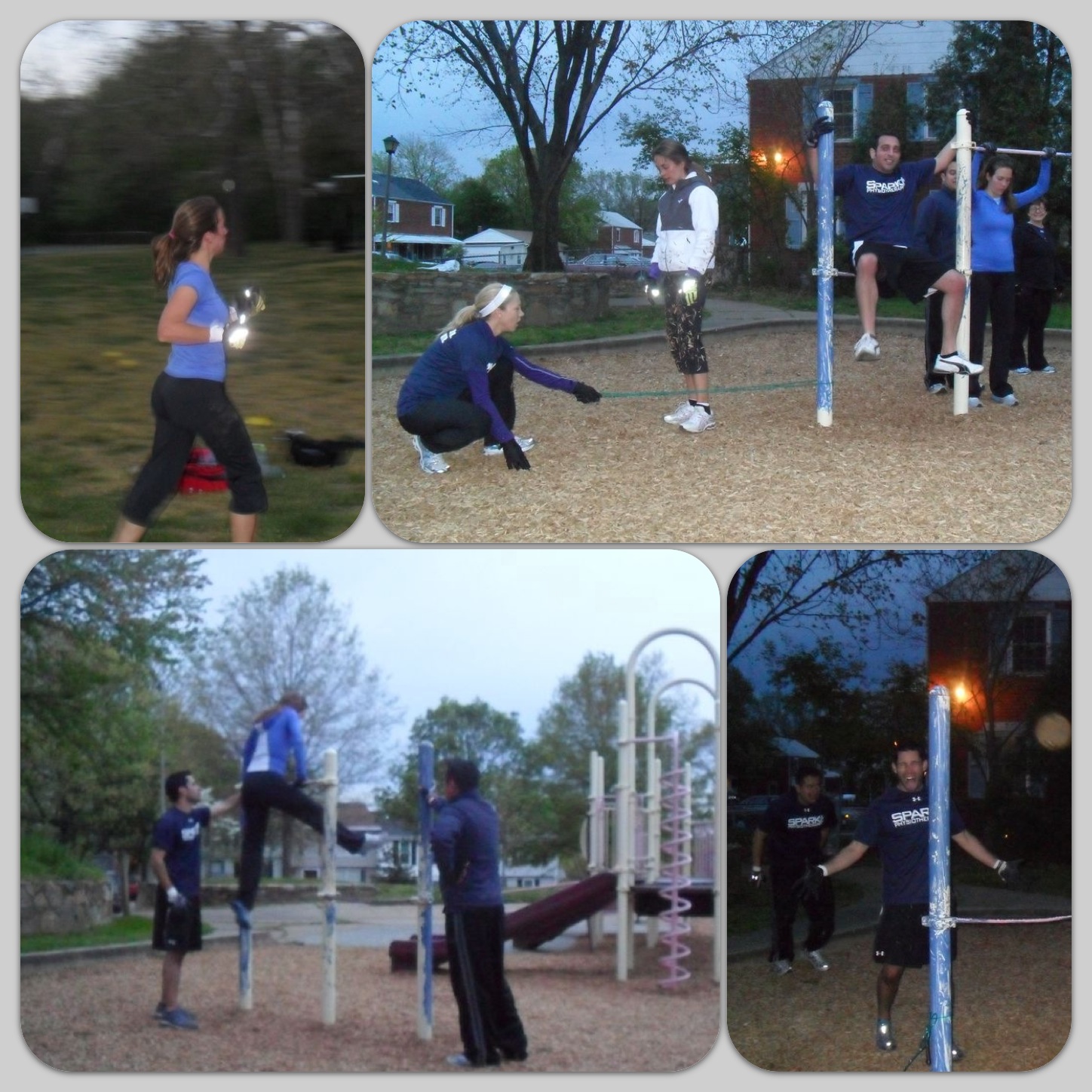
 SPARK loves the jungle gym!
Play is exercise people. Get to it!

 F'ing cold out there tonight!


What is with the booty risers?
GET YOUR HIPS DOWN!!

Hamming it up for the camera. Get moving.

Get lower and go that way.
Top pic is a SPARK Tough Special:
 inside hand down slalom sprints.
Only a 200 yards sprint or so. Nbd.

Gasser Hill suicides, bears and SEALs.
Designing these workouts was much
easier than doing any of them.
 
If you don't get your tail down your going to wind up on your back.

Spiderman lunge walk with slalom sprints.
Puke again? C'mon man!

Jump around! Jump around.
Jump up, jump up and get down!

I recall this as a painful rep; mostly
for my tail bone and my pride.
I was def not ready.

Stair ergs for 30 sec. 1:2 intervals x 10.
Talk about quad burn. Best part is all the small muscles of your feet that scream the entire time.
 
Some of us working harder than others. Too much fun.

Serious hops.
By the end of SPARK Tough no one needed much help on the power muscle ups.
 Bear crawl technique still could use some work though.
I guess that's what SPARK Tough II is for!
 

Tuesday, July 31, 2012

Running a "Difficult Wet-Dirt" Race?? Prepare like a Pro

As thousands descend on the sites of Spartan Races, Tough Mudders©, Warrior Dashes and races like them, we get questions about what to do to prepare for the week or day of the race. Here is what team  "SPARK It Up" is doing and you should too.

* Emphasize the importance of race-week nutrition and hydration.
Be sure to begin hydrating heavily at least 72 hours before the race. This means that our Saturday group should be drinking lots of water and limiting alcohol consumption beginning on Wednesday.


Make sure that you are properly loaded up with energy; a high fiber, high complex carbohydrate diet is a must. This should begin on Thursday and carry through to Friday evening.

A bowl of oatmeal and some fruit is a great race-day breakfast especially as you will likely not eat anything
again until the first rest stop. Fortunately, the folks at the Difficult Wet-Dirt Race© takes the worry out of in-race logistics: there is no need to bring carb gels or anything like that with you during the race. There are plenty of "refueling" stations throughout the course that have water, bananas and FRS chews. Use these resources and you will have all the fuel you need to complete the race.

* Gear check.
Make sure your sneakers haven't completely fallen apart. Make sure gloves are not terribly worn. Make sure your socks are adequately hole-less. Nothing is going to suck more than getting a blister or hot spot on your skin and have to run with that for 4-5 hours.

* Gear selection.
Most of us are set on the sneakers we want to use. Most of us have gloves we like. Other suggestions might include: leggings or tights, some form of arm sleeve or a top that will cover you completely. The only bad/painful experience we had in our race last year was being covered in fine sand after several of the crawling events and then having to spend time on our hands and knees in subsequent obstacles with a hard surface. That will tear your skin up QUICK!

* Run as a team.

This is not a race; it is a challenge to the finish. If you are fortunate enough to have trained with a team, then run with the team. If a teammate falls, be there to pick them up. If you want a challenge, do your work and the work that a teammate needs help with as well. If you need help through an obstacle use your teammates. Several if not the majority of the obstacles will absolutely REQUIRE the strength and ability of more than one person. Lean on each other and we will all be successful.
Race hard. Have fun.

Friday, July 13, 2012

A patient-friendly way to explain how the 'painful part' isn't always the problem. A Movement Econ analogy

So we are continually asked, "Hey, so how is what we're doing for my hips and my ankles going to help me? My knee is what's bothering me." Or, "When I went to PT before, they gave me a hot pack and used this sound machine to decrease my pain. Then they just gave me some exercises and none of it was as hard as this. Why aren't we working on those things?"

Well needless to say, this is not something we hear too far into treatment. After any real length of time our patients realize the method to our madness. That said, I find myself repeating a similar analogy that I find helpful and I hope you will too.

Me: Take a look at our door over there. It has three hinges. All of those hinges are in perfect working order and the door opens and closes just fine, right?

Pt: Right. Ok. So.

Me: So, let's say I remove two of the hinges. Will I be able to open and close that door?

Pt: Probably, but not for a long time.

Me: Right! It will open and close but after a little while that hinge will start to make noise, then it may loosen and once that process has started it won't be long before the entire hinge comes loose from the door frame and the door will no longer open or close at all. Makes sense, right?

Pt: Yes.

Me: So what might a person who doesn't know a bunch about doors say about this situation?

Pt: They would probably say you have to replace that hinge.

Me: YES! That's probably what they would say. Now, what would an experienced carpenter say about that door.

Pt: Replace the other hinges and the door will work better.

Me: Exactly. Now, there is still a problem with the bad hinge but until we address the what caused the this entire process in the first place we will not have completely addressed the issue. If the "fix only the painful part (aka: the obviously bad hinge)" method worked, you wouldn't be in PT for round 2.

From a purely academic stand point, this is just a way to explain regional interdependence (RI) without using those words. This construct of Movement Economics (our more patient-friendly concept of RI) we feel improves our pt buy-in and the overall therapeutic alliance.

Monday, June 18, 2012

Mud Madness FREE For All!

The SPARK Physio Mud Madness Prep Course is gearing up again! Session #2 begins tonight at 7PM at our Mill Rd location in Alexandria. We had such an awesome time during the first go-round and we’re looking forward to pushing even harder over the next 10 weeks.

As a bonus for all of our friends, we’re are designating the first 2 weeks of this MM Prep Session as the “MM Free For All”. Anyone and everyone is invited to try out this training course free of charge. Have a friend who you think can hang? Tired of explaning what ‘SEAL crawls’ or ‘shrimping’ is to your coworkers? Invite them along. Who knows: they might be able to last for a workout or two!

If you or a friend is interested, feel free to reach out.

Here's to the best Mud MadnessTraining Team out there! 

Tuesday, June 12, 2012

Mud Madness Prep Course: Weeks 9 and 10 training schedule

This is it! The final weeks of our Mud Madness training program. We're very proud of everyone who particpated in Session #1 and looking very forward to the beginning of Session #2 and our eventual race in September.

Whether or not you can join us to train in the coming weeks and months, be sure to stay tuned here for more training ideas and pics and descriptions of the drills we are performing.

Train hard. Have fun. Be safe.

Mud Madness!!
Week
#9
Venue:
Base Camp:
2609 S Walter Reed Dr, Arlington, VA 22206
Superman Hill to Fort Barnard Park
2101 S Pollard Street, Arlington, Virginia 22204
Venue specific move
TimeHigh stepping 
:00Dyno Warm-Up
:10Drill Circuit 1Stop and starts
High knee run
:15Drill Circuit 2High knee hurdles
Superman-hill sprints
Superman-hill kbell trot
:25Drill Circuit 3Vert jumps
High knee jumping 
Turds nest
:35Drill Circuit 1Sprints 
Bear crawls
:40Drill Circuit 2Up/downs
Crab walk
:50Drill Circuit 3Kbells on parade
Over/unders
Week #10
Venue:
HQ: Mill Rd
2331 Mill Rd, Alexandria, VA 22314
Carlyle Quad
330 John Carlyle Street, Alexandria, VA 22314
Venue specific move
TimeLog jammin'
:00Dyno Warm-Up
:10Drill Circuit 1Sprints
Ramp sprints
:15Drill Circuit 2Stop and starts
Rope/ramp relay
Stair erg
:25Drill Circuit 3Bounds
Hopping
Broads and verts
Kiss of mud
:35Drill Circuit 1SEAL crawls
Bear crawls
:40Drill Circuit 2SEAL crawls
Up/downs
Over/unders
:50Drill Circuit 3Bear crawls
Ramp sprints
"Haynesworth"