Click on the player below to listen to the show now.
(Also available as a free download on iTunes!)
Listen to internet radio with SPARK Physiotherapy on BlogTalkRadio


 The other bonus is that a PT's training spans many different orthopedic body systems. Lots of times, we'll see a client for an evaluation and that client has done a lot of research on their own or consulted their GP. Many times, while the diagnosis we see from a GP may be close, the true mechanical issue requires more thorough examination. Sometimes a problem that looks and feels like a herniated disc, for example, may actually be an issue of muscular or nerve tissue tension. This is where the manual physiotherapist shines! We are able to look at the entire movement picture and truly hone our care toward the problem area and not just the symptoms. This give our clients the most relief and the best chance that this issue does not crop up again. Just as you would see your GP regularly to make sure that everything is in working order, you should see your PT regularly for what we call a 'tune-up'. We'd much rather see our clients when they are pain free and work to keep them that way instead of only seeing them when they've had an injury that could have been avoided if we would have pointed out areas of weakness and addressed them.
 This one is a no brainer! There is no medical professional other than a dentist that can take care of your teeth like these folks. Have tooth pain or just want to stay ahead of the curve to keep those pearly whites gleaming? Make sure to have a good dentist in your corner.
  Lots of people will reserve space in their corner for acupuncturists, nutritionists, massage therapists, chiropractors or personal fitness trainers. This is also a good idea. Some people feel that having an expert in these disciplines helps to fill gaps between other professionals' knowledge.
  More people are working as hard as they can to excel at sports or other activities. What an awesome situation to be in! A team of pros dedicated to making sure that you function at the highest level and then seeing it all come together in the performance of a high level task. This is where we wish all of our clients wanted to be. The thing to be sure of here is that your 'skills' expert is aware of any movement or function issues that may be preventing you from performing a drill or exercise with perfect technique.


 Dr. Carlos J Berio, PT, DPT, MS, CSCS, CMTPT is a licensed Doctor of Physical Therapy, Certified Strength and Conditioning Specialist and a Certified Myofascial Trigger Point Therapist. In addition he holds a Master's Degree in Clinical Exercise Physiology. He has treated high school, collegiate, recreational, and professional athletes of various sports including baseball, softball, football, hockey, tennis, swimming, golf and the martial arts. His experience as a collegiate and semi-professional athlete as well as a professional baseball coach make him a sought after resource among elite level athletes on the field and in the training room. The concept of 'all the way well' in his work as a physical therapist and fitness professional is what continues to drive Dr. Berio to be the best movement specialist there is.
  Nowadays,
PT clinics, and PTs themselves, have made a violent shift in focus toward high
volume. Clinics are over-stuffed with patients vying for the eyes, ears and
hands of fewer PTs. The therapist becomes a glorified crossing guard; managing
traffic, logistics and paperwork. The high level care that we are capable of is
more often passed off to aides and technicians, most of which hold no license
and have minimal training. Oh, but it’s ok, because the PT is somewhere in the
same building, so it’s just like the PT is providing all of the care, right?
NO!
Nowadays,
PT clinics, and PTs themselves, have made a violent shift in focus toward high
volume. Clinics are over-stuffed with patients vying for the eyes, ears and
hands of fewer PTs. The therapist becomes a glorified crossing guard; managing
traffic, logistics and paperwork. The high level care that we are capable of is
more often passed off to aides and technicians, most of which hold no license
and have minimal training. Oh, but it’s ok, because the PT is somewhere in the
same building, so it’s just like the PT is providing all of the care, right?
NO!
 It starts with doing your homework! When you call to set up
an evaluation or treatments, ask:
It starts with doing your homework! When you call to set up
an evaluation or treatments, ask:
 Baseball players perform one of, if
not, the most violent tasks in sports. The act of throwing a baseball requires
the highest amounts of torque, angular velocity and power than any other single
sport task. With our experience in sports rehab, strength and conditioning and
coaching, we have been able to develop a great niche in treating these
athletes. In this post, I’d like to point out some of the “typical” findings
and how we’re getting them off the table and back out onto the field for good.
Baseball players perform one of, if
not, the most violent tasks in sports. The act of throwing a baseball requires
the highest amounts of torque, angular velocity and power than any other single
sport task. With our experience in sports rehab, strength and conditioning and
coaching, we have been able to develop a great niche in treating these
athletes. In this post, I’d like to point out some of the “typical” findings
and how we’re getting them off the table and back out onto the field for good.  'Tommy Baseball’: a 17 year-old, 5’11”,
180lb high school baseball player walks into your clinic complaining of right
shoulder pain he recently started feeling after a tournament over the weekend. He
is a right handed pitcher and has been playing for years without shoulder pain
so he “doesn’t understand why all of a sudden this is happening”. He has an
exercise program that he has been on for the past year. The program was written
for him by his PE teacher. He received a scholarship to a DII university and
needs to be pain-free and ready to play at a much higher level within the next
3-4 months.
'Tommy Baseball’: a 17 year-old, 5’11”,
180lb high school baseball player walks into your clinic complaining of right
shoulder pain he recently started feeling after a tournament over the weekend. He
is a right handed pitcher and has been playing for years without shoulder pain
so he “doesn’t understand why all of a sudden this is happening”. He has an
exercise program that he has been on for the past year. The program was written
for him by his PE teacher. He received a scholarship to a DII university and
needs to be pain-free and ready to play at a much higher level within the next
3-4 months.  Where do you start? Almost all
rehab professionals are familiar with the tests that we would use to come to
the actual diagnosis. There are also some tests that coaches and trainers could use to see if an issue is serious or not. This is a great start but how do you relate this back to
throwing a baseball and MOST IMPORTANTLY, how can we get this player back to
competition without increasing his risk of being back in PT soon thereafter?
Where do you start? Almost all
rehab professionals are familiar with the tests that we would use to come to
the actual diagnosis. There are also some tests that coaches and trainers could use to see if an issue is serious or not. This is a great start but how do you relate this back to
throwing a baseball and MOST IMPORTANTLY, how can we get this player back to
competition without increasing his risk of being back in PT soon thereafter?  1. Manual
rehab techniques to improve the soft tissue (muscle) and joint
mobility
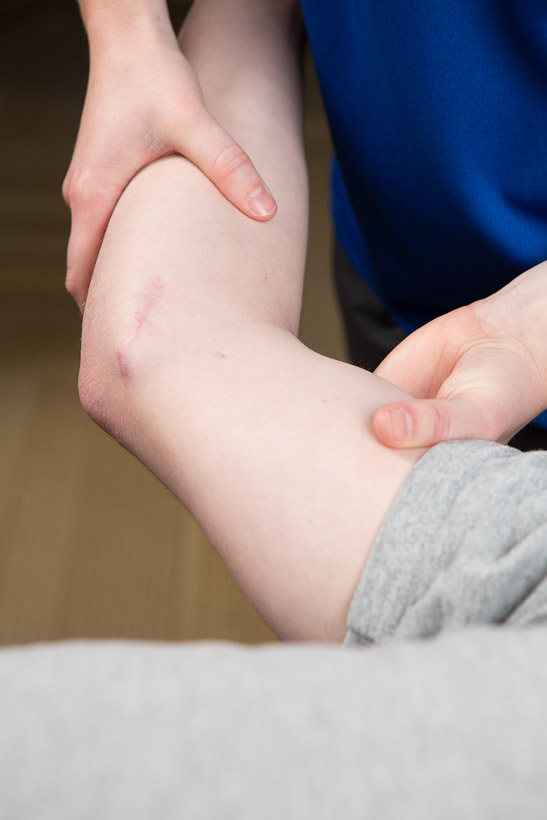
1. Manual
rehab techniques to improve the soft tissue (muscle) and joint
mobility  |
| Advanced Rehab and Treatment of the Elite Thrower |


